Calling in from the US, our presenters this session showcased two intriguing empirical studies.
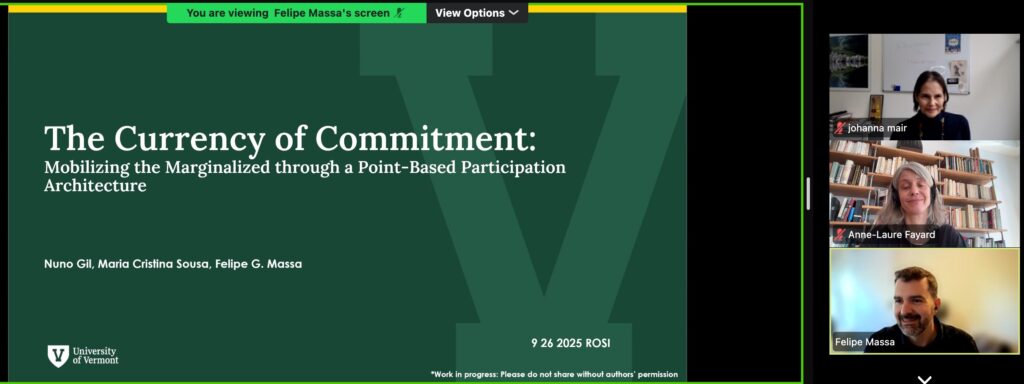
Felipe Massa started off the session with his work “The Currency of Commitment: Mobilizing the Marginalized through a Point-Based Participation Architecture” co-authored with Nuno Gil and Maria Cristina Sousa. Felipe began with the question: “How do we include the marginalized?”. While social movements intend to create participatory and decentralized forms of organizing, distributed movements without clear goals tend to fall apart and lose sight of their overall aims. Decentralization doesn’t mean disorganization, Felipe said. He emphasized that change doesn’t occur with energy alone, but when this energy is channeled in a direction towards their goals while maintaining inclusivity to marginalized groups. By following a social movement organization in São Paulo, Brazil, Felipe and his co-authors show how organizational attributes create a self-reinforcing cycle that allow the organization to maintain momentum toward social change. Following the presentation, we had a lively discussion surrounding what mechanisms may be underlying these cycles, how they were able to maintain inclusivity, and wondered when breakdowns may occur.
Next, we were treated to Trevor Young-Hyman’s presentation of his paper “Durable Decentralization: How Democratic Deviation Allows Organizations to Temporarily Centralize While Preserving Commitments to Decentralization” co-authored with Michael Y. Lee. Trevor explained his multiple case study where four typically decentralized organizations approached the COVID 19 pandemic in distinct ways. He began by stating that while organizations may aim to organize in a decentralized manner, hierarchy is always lurking in the background. When crisis hits, the majority of organizations centralize, bringing these hierarchical structures to the fore. In this study, Trevor and Michael seek to uncover how organizations centralize in a way that doesn’t undermine their commitments to decentralization. Their findings highlight the role of openness, transparency, and ambiguity in this process, and they uncover how democratic rules and processes help organizations maintain their commitments under pressure. Trevor’s presentation intrigued our members and sparked many questions from the audience.